I think I need to bring this blog to its natural conclusion.
For those of you reading it for information about Moldova, you need to start at the beginning of 2008, because the recent posts barely touch upon my time there.
Moldova is an incredible country full of contradictions and confusion. If you're assigned there as a PCV it will be a experience you will not forget.
Thanks to all that read it; sorry it got off topic so much.
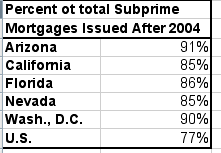
Subprime mortgages took off after 2004. Subprime mortgages had been around for a long time. But their popularity took off in late 2004. Most subprime mortgages were issued after 2004, according to a survey by the New York Federal Reserve.
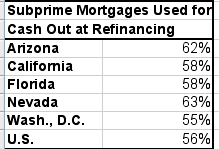
Subprime mortgages were not used primarily for new home purchases. One of the familiar media narratives is that subprime loans were used as part of a government policy to make home ownership affordable to low-income people. But in fact most subprime loans were used to refinance existing mortgages, and not for new home purchases. And most of those refinancings were also used by home owners to take out more cash from their home equity.
Many people who would have qualified for a traditional prime mortgage took out a subprime mortgage instead, based on the recommendation of mortgage brokers, who earned bigger upfront fees from the subprime product.
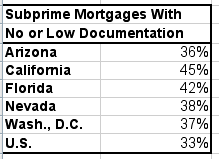
A big percentage of subprime mortgages had inadequate documentation. It's easy to engage in mortgage fraud if you don't need to prove your income or your net worth. And the proliferation of "no income, no asset" mortgage loans did just that. It was an invitation to fraud. This product was most popular in California and Florida.
Most subprime mortgages had adjustable rates. Most subprime mortgages had low introductory interest rates that reset after a few years. Often, when the rates were reset, homeowners discovered they were no longer able to afford the monthly payments.
Subprime Mortgages With Adjustable Interest Rates Arizona 73% California 69% Florida 65% Nevada 68% Wash., D.C. 68% U.S. 61%
For an incredibly detailed analysis of all the math involved in the mortgage crisis, go here.
I came to this country and worked hard also.. and, like you, have been lucky enough to be successful. This country is wonderful that way - if you work hard you have a good chance of being successful. But many people work very, very hard and are not successful - and not because they are stupid, or lazy. The difference between Obama and his predecessors is that he realizes that the people who work hard and don't make a lot of money, or work hard and don't have health insurance, or who worked hard all their lives and now - in their golden years- have little to show for it also deserve some minimum level of dignity.
And yes, someone has to pay for it, and I'm happy for it to be me and people like me, because there for but for the grace of God. It's not punishing the successful, it's realizing that hard work is only part of the equation and we as a society need to recognize our obligations to those people who have held up their part of the bargain but didn't end up on the winning side (and children get an automatic pass).
The US is hobbled by bigotry but it has an unrivalled vitality that pushes it ever forward
Andrew Sullivan
America can drive you up the wall. To Europeans and world-weary Brits, it can sometimes seem almost barmy in its backwardness. It is a country where one state, Arkansas, has just refused to repeal a statute barring atheists from holding public office but managed in the same session to pass a law allowing guns in churches. It incarcerates a higher percentage of its population than even Russia and aborts more babies per capita than secular Europe.
Darwin remains a controversial figure, but Sarah Palin was a serious candidate to be vice-president. Last week the California legislature took five days to prevent the entire state from going bankrupt; and more than three months after the election, and five months since the financial system went kablooey, the Treasury secretary had not mustered the staff sufficient to craft the details of a rescue package for the banks.
There are times in the quarter of a century since I arrived in America that I have been tempted to throw my hands up in frustration. To give a brutal, personal example, I’ve lived in the US since 1984. I’ve made a home and a life here. But I still cannot even begin the process of becoming a citizen because the United States makes it illegal for anyone with HIV to get a green card.
The ban was passed in the 1980s in a moment of total, ignorant panic. It took two decades to repeal it last summer, and the government bureaucracy still hasn’t changed the regulation. There are only 12 countries in the world with such a draconian policy on HIV-positive immigrants: Armenia, Brunei, Iraq, Libya, Moldova, Oman, Qatar, Russia, Saudi Arabia, South Korea, Sudan and the good old USA. Quite some company, no?
Another small insanity: the residents of the city I live in, Washington DC, America’s capital, do not have any representation in Congress. Since the founding of the country, the district has never been formally a part of a state, and so cannot, according to the constitution, have representatives in the House or the Senate. Imagine the residents of Westminster not having any MPs in the Commons. The residents of Bagh-dad, in fact, have more democracy than the residents of Washington but no one in government cares enough about this actually to amend the constitution to make that change.
And yet I stay and love it and defend it, even as it can push me to bang my head against the wall at times and may eventually throw me out altogether. Why? Because I’ve learnt over the years that the constitutional system that seems designed to prevent change has more wisdom in it than some more centralised parliamentary systems; and because the very chaotic, decentralised and often irrational mess of American state and federal politics also allows for real innovation and debate in ways that simply do not occur as vibrantly elsewhere. The frustration and innovation are part of the same system. You cannot remove one without also stymieing the other.
Take gay rights, a cause dear to my heart. Many Europeans feel quite smug about their enlightenment, and the transformation of the debate in Britain in the past decade has been as profound as it has been welcome. But few doubt that America pioneered the gay rights movement, as the movie Milk, up for eight Oscars tonight, underlines. New York, Los Angeles and San Francisco in the 1970s forged a liberation movement that changed gay lives throughout the world.
Yet even now, though I have a marriage licence, something no gay couple in Britain have, my five-year relationship is not recognised by the federal government. In Massachusetts, a state where gay marriage is legal and where I married my partner Aaron in August 2007, the licence is no different in any respect from that given to heterosexual couples. Civil partnership may provide rights at a national level, but it is still indeli-bly a separate and lesser institution than marriage itself, and offers a lesser measure of the social, psychological and cultural acceptance that civil marriage provides.
In California, gays just suffered a horrible setback as a majority narrowly voted to take away marriage rights. But at least they had a chance to get them in the first place. And the debate was a real and raw one – which made victory more meaningful and defeat more profound.
In America, the bigotry you face is real, unvarnished and in the open. In Britain, it can come masked or euphemised or deflected into humour. It hurts much more to punch a brick wall than to punch a deep velvet cushion. But if you punch hard enough, the wall will one day crumble, while the pillow will constantly absorb the blows.
There is plenty of religious bigotry and fundamentalist rigidity and crude sectarianism in America. But there is also a clear and invigorating religious energy that takes the question of God seriously and does not recoil from it in apathy or world-weariness. Give me a fundamentalist to argue with any day over someone who has lost the will to care that much at all.
On race, of course, this is especially true. No civilised country sustained slavery as recently as America or defended segregation as tenaciously as the American South until just a generation ago. In my lifetime, mixed-race couples were legally barred from marrying in many states. But equally in my lifetime, a miscegenated man who grew up in Hawaii won a majority of the votes in the old slave state of Virginia to become the first minority president of any advanced western nation.
That is the paradox of America; and after a while you find it hard to appreciate anything more coherent. What keeps America behind is also what keeps pushing it relentlessly, fitfully forward.
That Canadian genius Leonard Cohen put it best, perhaps. In his anthem Democracy he called the United States “the cradle of the best and of the worst”.
You live with the worst because you yearn for the best, because the worst in its turn seems somehow to evoke the best. From the civil war came Abraham Lincoln; from the Great Depression came FranklinD Roosevelt; from segregation came Martin Luther King; and from George Bush came Barack Obama. America may indeed drive us up the wall, but it also retains a wondrous capacity to evoke the mountain top and what lies beyond.
S. 162 would provide greater accountability of taxpayers' dollars by curtailing congressional earmarking.
It's a Feingold, McCaskill, McCain "joint". Support it by emailing your legislators. It's just in the senate, so you can go to www.senate.gov, but it doesn't hurt to tell your house folks to, and you can find out who those people are here: http://www.votesmart.org/
Dear Obama, I hope this letter reaches you in the best of health and condition, following your victory in the presidential race.… I guess the best thing about the White House is the experience of being there for a term or two terms and really sucking everything up, be it good or bad. Sincerely, Mohammad Jama, age 14 Ann Arbor, Mich.
Dear President Obama, The first thing you need to do is put your stuff in the White House. Be careful, Abraham Lincoln haunts one of the bedrooms. Look around the White House. Meet with your helpers. Get a puppy. Talk to America. Make a speech. Sincerely, Matthew Wong, age 8 Chicago
Dear Mr. Obama, As president, I would move into the White House and get some people to help me with my homework. I would fill the White House with chocolate and gravy (but not together) and mashed potatoes or maybe fill it with root beer. I'd drive through the White House on a boat. We'd make the floor out of mashed potatoes and the house would be filled with mashed potatoes. … I'd have a couch made out of pudding that you could eat with a giant spoon. And I'd have a pizza carpet. After we'd eaten all of our furniture, we'd buy real furniture. Amir Abdelhadi, age 6 (as dictated to Katie McCaughan) Chicago
Here is a list of the first ten things you should do as president: 1. Fly to the White House in a helicopter. 2. Walk in. 3. Wipe feet. 4. Walk to the Oval Office. 5. Sit down in a chair. 6. Put hand sanitizer on hands. 7. Enjoy moment. 8. Get up. 9. Get in car. 10. Go to the dog pound. Please enjoy your experience as president. Sincerely, Chandler Browne, age 12 Chicago
Dear Mr. Obama, Hey, I'm Sheenie, I'm kinda a poet. I really hope you put America back together. No pressure though. Sheenie Shannon Yip, age 13 Seattle
Dear President Obama: You are awesome!!! Some things you should do are: 1. Stop the use of oil in cars. 2. Clean up the ocean. 3. Help animals that are endangered. 4. Help immigrants get better jobs. 5. Give money to schools. 6. Fire the governor of California. Love, Hilda Herrera, age 12 San Francisco
Dear President Obama, Could you help my family to get housecleaning jobs? I hope you will be a great president. If I were president, I would help all nations, even Hawaii. President Obama, I think you could help the world. Chad Timsing, age 9 Los Angeles
Dear President Obama, If you could lower gas prices, it would be good so people could not waste their money. Or if they waste all their money, they should have more chances before they become homeless. Jackson Huang, age 10 Los Angeles
I haven't written an actual posting in a serious long time, and truth be told, I have much to update about.
Prague.
Egypt.
Moldova.
New apartment.
All these things have kept me busy in the past few months - kept me away from my computer. Or at least, away from writing anything.
Plus, when the election ended, things just kind of - crashed emotionally. It was a serious buildup of emotion and fear, and when that ended it was such a relief that I didn't even watch the news for awhile.
Yes Rachel Maddow, I... forsoke you? forsaked you? But only for a few months. Only until the inauguration. Now I'm back to my "no he did not do that!" state of mind.
Except for now it seems to be more of the "yes, he *totally* did that!" kind of exclamations.
Anyway...
I'm in the midst of this momentously huge task of Model United Nations, and it's sure been a tough project. We're greatly expanding it, and it's hard to do a project in a nation that has very little internet access and sketchy phone system. Oh, do I have stories.
But the competitions for MUN start in two weeks, and I am finishing trainings in romanian (which are horrible) so that the local competitions can start, and once they're finished, I'm finished! Huzzah!
The end of February, folks, I'll have so much more free time. But I'll try to be on here more, promise promise.
This is a ridiculously long article to republish on a blog.
I don't care. It deserves a reading. Not that anyone will. But it will make it easier for me to find and quote later.
"The inauguration of the 44th president looked like the most dramatic debut since the Beatles arrived in New York. But now it's time for Team Obama to produce results. For three of President Obama's top priorities -- energy and climate change, health care, and jumpstarting the economy -- he would do well to look toward "old Europe" for guidance.
Energy and the Environment The European Union recently displayed global leadership by enacting its 20-20-20 Plan: agreeing to cut human-produced carbon emissions that contribute to global warming at least 20 percent by 2020. They will do this by ramping up renewable energy technologies to 20 percent of energy usage, as well as by implementing far-reaching conservation measures and enacting the world's most ambitious carbon-trading program.
Displaying an important principle that will be crucial to any global climate agreement replacing the Kyoto Protocol, the richest European nations will contribute a greater share toward combating climate change.
Importantly, the EU has not allowed the recent economic crisis to thwart its drive. EU Commission President José Manuel Barroso told the BBC, "The financial crisis is not an excuse. On the contrary, we can make it a win-win situation. We can create more green jobs; we can promote more investment in the low-carbon economy of the future."
Indeed, the European wind and solar industries are creating thousands of jobs, many of them in rural areas where job creation can be difficult. Germany's economy has received a major boost from a massive investment in the renewable energy sector. Tens of thousands of Germans are employed in the wind-turbine industry. Germany's entire renewable energy industry -- including wind, solar and biomass power - included 249,300 jobs in 2007, a 50 percent jump from 2004. On a per capita basis, that is comparable with creating 1 million U.S. jobs.
A study by the German government predicts that by 2020 there will be 400,000 domestic jobs in the renewable energy sector. Other EU nations are enjoying similar economic surges; in Portugal, a massive solar plant is bringing jobs and development to the traditionally poor Alentejo region, 125 miles southeast of the capital Lisbon. The business of wind, solar and other renewables is growing deep roots in fertile European soil, and Europe is leading by example. In a friendly challenge to then President-elect Obama, Barroso said, "Our message to our global partners is: Yes, you can ... especially to our American partners."
Health Care Similarly on health care, the Obama administration can learn from what has worked in Europe. The World Health Organization (WHO) rates European countries as having the best health care systems in the world, spending, on average, far less than the United States for universal coverage and quality results. France has the top-rated health care system, while the United States is ranked 37th -- just ahead of Cuba and Slovenia. In the Czech Republic, a proposal to introduce a $2 co-payment per office visit nearly toppled the government, as health care is considered a basic right in the social contract.
The United States ranks 28th in the world in infant mortality, at seven deaths per 1,000 live births, tied with Poland and Slovakia, and substantially higher than Sweden (3.4 deaths), France (4.3 deaths) and Germany (4.5 deaths). In life expectancy, the United States ranks 29th, its 77 years lagging behind Italy (81 years), France (80 years), Sweden (81 years) and Germany (79 years), and about the same level as South Korea (76 years) and Cuba (77 years). The United States has fewer per capita physicians, nurses and hospital beds, fewer MRI and CT scanners than the average for other advanced nations, and has the highest rate of medical errors (receiving the wrong medication, incorrect test results, a mistake in treatment or late notification about abnormal results). And of course, the U.S. has some 45 million Americans without health care, with that number rising as more Americans join the ranks of the unemployed and lose their employer-based health care.
In addition to providing better health coverage, Europe also manages to spend less. According to the WHO, the United States spends the equivalent of 16.5 percent of its economy on health care, about $6,100 per person, compared to an average 8.6 percent in EU countries. France spends just $3,500 per person, or about 10.7 percent of its economy. As Dr. Christopher Murray, director of WHO's Global Program on Evidence for Health Policy, says, "Basically, you die earlier and spend more time disabled if you're an American rather than a member of most other advanced countries."
How do the European countries manage to provide better health care than most Americans receive for about half the per capita cost? While there are differences from nation to nation, there also are some broad generalities to point to, as well as national specifics. These give us a pretty good snapshot that should be instructive to the Obama administration as they grapple with a health care system that is continuing to hurt American workers, businesses, and increasingly will hurt American competitiveness in the global economy.
The first overriding difference between American and European healthcare systems is one of philosophy. The various European healthcare systems put people and their health before profits. It is the difference between health care run mostly as a nonprofit venture with the goal of keeping people healthy and working, or running it as a for-profit commercial enterprise. For example, UnitedHealth Group CEO William McGuire received an obscene $124.8 million in compensation in 2005. He's just one of many grossly overcompensated kingpins of the U.S. health care industry. If nothing else, the U.S. health care system provides a valuable tale illustrating that corporate profits and affordable, quality universal health care are not a viable mix.
The second major difference between American and European healthcare is in the specific institutions and practices that flow from this philosophy of "health comes first." Contrary to stereotype, not every country in Europe employs government-run, "socialized medicine." Unlike single-payer Britain or Sweden, France, Germany and other nations have figured out a third way hybrid with private insurance companies, short waiting lists for treatment and individual choice of doctors. This model is based on the principle of "shared responsibility" between workers, employers and the government, all contributing their fair share to guarantee universal coverage. Health care is mandatory: everyone pays what they can afford into the health care fund so that everyone can receive health care.
A similar health care plan now is used in Massachusetts, and has been proposed by Governor Arnold Schwarzenegger in California, but with two essential differences: in France and Germany, the private insurance companies are non-profits. Doctors, nurses and health care professionals are paid well, but you don't have corporate health care CEOs making hundreds of millions of dollars. Generally speaking, the profit motive has been wrung out of the system.
The second key difference is in the area of cost controls. In France and Germany fees for services are negotiated between representatives of the health care professions, the government, patient consumer representatives, and the private nonprofit insurance companies. Like in America's publicly financed Medicare system (which provides health care to the retired and elderly), the negotiations establish a national agreement for treatment procedures, fee structures and rate ceilings that prevent health care costs from spiraling out of control. In the end, this not only benefits personal health, but also has been good for European businesses, which aren't exposed to the soaring health care costs that have plagued American businesses.
Economic Stimulus The Obama administration also could take notes from how the Europeans are jumpstarting their economies. Europe sometimes is criticized for its lack of unity, but sometimes that multi-headed hydra affords certain advantages. Having so many powerful nation-states allows each nation to act as a laboratory for the others, learning from each other's successes and shortcomings.
For example, during the massive financial meltdown in the fall of 2008, as markets reeled and the US announced a $700 billion bailout plan, Europe was harshly criticized for its initial failure to craft a continent-wide bailout. Eurosceptics saw it as another example of Europe's disunity and weakness.
But that was a rush to judgment. Each country initially tried its own bailout formula, and less than two weeks later the British strategy under Prime Minister Gordon Brown emerged as the most effective. Much of the rest of Europe followed, as did the United States in a change of tactics from Secretary of the Treasury Hank Paulson's original plan, which had proven to be so ineffective.
The European plan also includes tighter controls over the bailout money, equity in the banks, reductions in dividends and concessions from the bankers (including restrictions on executive pay in some countries), all of which were lacking from the US bailout. And Europe already has enacted a fiscal stimulus worth hundreds of billions of dollars at the continental and national levels, while Americans still await Obama's plan. Europe is looking relatively light on its feet, while the U.S. has looked flatfooted.
With a half billion people, Europe is the largest, wealthiest trading bloc in the world, producing nearly a third of the world's economy -- as large as the U.S. and China combined. While its critics have derided Europe as a land of "creeping socialism," in fact Europe has more Fortune 500 companies than the US, China or Japan.
Like the United States, Europe is fighting to pacify the rising economic floodwaters. But something about Europe and its "social capitalism" seems particularly well-suited to this make-or-break century challenged by a worldwide economic slump, global warming and new geopolitical tensions. Team Obama would do well to take notes."
Steven Hill is director of the Political Reform Program at the New America Foundation. His book "Europe Rising" will be published by the University of California Press in September 2009.
If there is one thing Mr. Obama has not gotten around to changing, it is the Oval Office décor.
When Mr. Bush moved in, he exercised his presidential decorating prerogatives and asked his wife, Laura, to supervise the design of a new rug. Mr. Bush loved to regale visitors with the story of the rug, whose sunburst design, he liked to say, was intended to evoke a feeling of optimism.
The rug is still there, as are the presidential portraits Mr. Bush selected — one of Washington, one of Lincoln — and a collection of decorative green and white plates. During a meeting last week with retired military officials, before he signed an executive order shutting down the prison at Guantánamo Bay, Cuba, Mr. Obama surveyed his new environs with a critical eye.
“He looked around,” said one of his guests, retired Rear Adm. John D. Hutson, “and said, ‘I’ve got to do something about these plates. I’m not really a plates kind of guy.’ ”
From "White House Unbuttons Formal Dress Code" in NYTimes by Sheryl Gay Stolberg
There was only one force powerful enough to dampen the Internet’s hunger for all things Obama yesterday: Barack Obama himself.
Of course.
Check out the chart below, via the “Official Google Blog,” which shows the overall volume of queries at the search engine giant yesterday.
That valley in the middle of the graph? That’s the period when Obama actually spoke during his inauguration ceremony, starting a little after noon Eastern time. That’s one powerful speech.
I personally believe that Al-Qaeda is going to start some s*it in the next few months. How can they not? Their credibility has been blown.
And if the news of Mumbai today is anything to go by, well, I'm not too far off the mark.
But here's the thing: When Al-Qaeda releases weak videos calling the President-Elect of the United States a House Negro, and then starts whining when their video isn't well received in the foreign or native press, you kind of know something is going right. The wind has truly gone out of their sails, because it's kind of hard to be scared of whiners. These aren't impressive people, they're just bullies, and right now, they're bullies who are having their biggest weapons taken away from them. I can no more be scared of them than I can be scared of an earthquake or a car accident
Don't you think?
When Al-Qaeda starts complaining that the media is unfairly biased towards Barack Obama....
Well, maybe they should talk to Mark Halperin. I'm sure he'd *totally* be fair and balanced.
Iraqi Blogger: I am so happy today. I feel hope in the wind. Obama is the elect president of the U.S of A.
Am I happy for Iraq? I don't know. I don't know what will happen and I'm afraid. Will he pull out the troops? Will he care enough to reach a good compromise – fair to the Iraqi people? Or will he have to go overboard in some issues just to prove that he's American? Can he withstand the pressures?
But in spite of all my fears, I am so happy for America - You have come such a long way. You had the strength, the will to elect this man of change. And with all my heart I hope he puts America on the path to recovery. To see America again on the pedestal of freedom and democracy, a benign force that heals instead of hurts, unites instead of divides – soon inshalla.
I wish to congratulate you all.
Prominent Saudi columnist Dawood al-Shirian. "Today, reality in America has superseded fantasy. ... Americans have struck a deadly blow to racism all over the world. Americans have regained themselves and have regained the American dream. The picture of the U.S. that was disfigured by the Republicans in the past eight years fell from the wall today. The picture of the America we had in our minds has taken its place."
Syrian Daily: "We Hereby Declare Obama the 44th President [Before It's Official]... Even If It Might Be Considered Irresponsible Journalism"
In its headline, the Syrian daily Al-Watan named Obama president even before the official results were announced. The editorial that accompanied the headline explained: "We wanted to declare Obama president... as a show of solidarity with millions of Americans, Arabs, and colleagues in the world media who [all] yearn for 'change' in U.S. foreign policy. They are all betting on Obama - who has been waving the slogan [of change]... in hope that he will be different not only in the color of his skin, but also in his view regarding Washington's policy towards the world...
"Some claim that if Obama wins he will be no better than Bush, if not worse... They may be right, since it is well known that no American president has ever stood on the side of the Arabs - rather, they have all stood on the side of Israel...
"Yesterday was undoubtedly a long, exhausting, and historic day by any standard. The American people [voted] with a vigor not seen in any [previous] U.S. presidential election, in a bid to make history and change the ugly face of the U.S.
"Out of respect for them and for everyone who voted for change, and out for respect for the souls of the Syrian, Iraqi, and Arab martyrs, we hereby declare Obama the 44th president of the U.S., even if it might be considered irresponsible journalism. We are sure that our readers will forgive us if we turn out to be wrong - [a possibility] for which we do not hope."
Mostafa Eqbali, a merchant in the Iranian capital, Tehran: "Let me tell you that now I believe in American democracy. Honestly, I did not think that Obama would be president. I thought that the invisible hands of the big trusts and cartels would not allow a black man to be president of the United States."
A journalist from South Africa:
Damn, I love Americans. Just when you’ve written them off as hopeless, as a nation in decline, they turn around and do something extraordinary, which tells you why the United States of America is still the greatest nation on earth. But too, what is happening in America and Kenya holds lessons for politicians everywhere, and South Africa would do well to take heed.
Britain's Guardian newspaper: "Today is for celebration, for happiness and for reflected human glory. Savor those words: President Barack Obama, America's hope and, in no small way, ours too."
MaliPresident Amadou Toure: "The United States has given a lesson, a lesson in maturity and a lesson in democracy."
Japanese artist Terumi Hino: "Americans overcame the racial divide and elected Obama... I think this means the United States can go back to being admired as the country of dreams."
Nelson Mandela: "Your victory has demonstrated that no person anywhere in the world should not dare to dream of wanting to change the world for a better place."
Tristram Hunt, a British historian: Mr. Obama "brings the narrative that everyone wants to return to — that America is the land of extraordinary opportunity and possibility, where miracles happen."
And something written BEFORE the election by a journalist in Ramallah:
"But what if the face of America were Obama’s instead, and the warmth of feeling extended to Americans could not instinctively be denied their leader?What if the posters of Mohammed Ali would come down and posters of, of all things, the US president would be filling their spaces—filling, that is, some of the holes in the hearts of fruit vendors, terrified by globalization, from Palestine to Jakarta?Obama’s campaign, and many pundits, have made the point, so I won’t go on about it.But I thought I might report that one cannot take a cab in Ramallah and not run into what this means."
And some videos:
A New York City Subway
Europa
Sydney, Australia (although this is what *my* party looked like)
Obama City, Japan
Where I wanted to be more than anywhere else in the Whole World
But probably my favorite video, just because it's my favorite story: Washington DC, the White House
People just flooded out into the streets, apparently, and ended up marching to the White House in an uncoordinated march of joy. I heard that someone hung up a sign saying "Welcome Home, Malia and Sasha."
"The greatness of America lies not in being more enlightened than any other nation, but rather in her ability to repair her faults." Alexis de Tocqueville
On the Eve of the Millenium, I spent my night alternating between partying on the beach on South Padre Island in Texas and running back to the condo room my friends and I had rented so that we could watch as each time zone turned over, starting with New Zealand. On that particular island, we learned that on New Years Day it's tradition for people to run out into the sea to meet the sunrise; that year they happened to greet the dawn of a new age as well.
I remember the feeling of trepidation as we waited for Moscow's New Year - Yeltsin had just stepped down unexpectedly, and no one really knew why. Despite a cancelled state celebration, people gathered in Red Square and threw their own party - complete with homemade fireworks.
Cairo got in on the fun, and you can't really beat a light show against the pyramids. Of course, unless I'm mistaken, it wasn't technically their New Years, but who didn't want to join in on the Millenium Party?
The successes of these initial shindigs, and the constant tv images of everyone gathering, was intoxicating. Who needed the cheap Pabst Blue Ribbon we had bought?
But it wasn't until I watched images of Nigeria count down that I became, for lack of better words, giddy on the history I was witnessing: the people in the capital there were singing and dancing to Madonna's "Holiday." Yes, in my mind, the world was united, by Madonna.
I still can't listen to that song without getting a little emotional, because it reminds me of the feelings I had after that night. Nothing bad had happened, despite dire predictions. Everyone just... paused... for one night... in a single and common expression of hope and joy. And it made me feel so... excited, and proud, and hopeful. That feeling lasted for a surprisingly long time.
I have to tell you, that this was the same feeling I had on November 5th.
I spent election day and night in London. It was interesting to be away from the United States - to watch and listen to non-Americans while they watched us with bated breath make this one ginormous decision.
I spent my night at the London School of Economics. They hosted one of the many all-night election parties in London, as indeed there were all-night election parties all around the world.
I was surrounded by Americans, Brits, Indians, Irish, and countless people from other nations. So many people came to the party that they had to shut the building down - we had become a fire hazard.
People counted down the closing of the polls in each area like it *was* New Years, cheered - not just when a state was declared for Obama, but when polls showed positively for Obama... even if only 2% of the precincts were reporting.
I found that kind of silly, but I'll admit the enthusiasm was catching.
People who know me know that for the past two years, I've been pretty focused on Obama becoming President. I can list a whole host of reasons that I have for being supportive of him, including the fact that I think the man is a chess player of a politician from the great city of Chicago, and god knows we need a long-term thinker who is comfortable playing some rough and tumble politics in the White House.
But I have a much more global reason for being so supportive.
While I certainly can't claim to be a globe trotter, I have traveled enough in the past decade to know that being an American abroad is not something that works in your favor (and yes, our downward spiral started before the Bush administration). I've heard the term "American" thrown around like a curse-word in multiple languages.
But on November 5th, it's like a switch was thrown around the world.
That day, walking around LondonTown, people heard my accent and congratulated me; I even got high-fived at a grocery store. Obama was everywhere in the news, and on the television. Commentary and images suggests that my story of international support is anywhere from unique.
What has started to become crystal clear to me is that people from around the world have been hungry for America to be... America again; to be the America that people idealize, the America that dreams are made of, and where dreams can come true for anyone from anywhere. America may be mocked for being overly idealistic and hopeful, but it seems that the world wants to have a Shining Beacon of Hope-iness nation to look to. The speed in which the world switched back to the belief that we are that nation is astounding - and is indicative of just how *hungry* people were to have that belief back again.
Am I overstating? Being dramatic? Maybe. But then again, maybe not.
The last big Democrat event in Grant Park-Chicago was the Convention in 1968, when 20,000 police and national guardsman gassed and beat 10,000 protesters, doctors and reporters. The Mayor at the time (the father of the current mayor) remained unrepentant of the event to his last days. As newscasters projected the images into the homes of America, the protesters chanted "The Whole World is Watching, The Whole World is Watching."
The events of that night changed the course of American politics.
Just a little over 40 years later, in exactly the same place, I feel like it's fair to say that the whole world was watching as Americans did something that no one in the world thought we'd ever do - elect a black man named Barack Hussein Obama who grew up in Jakarta and Hawaii to be the President of the United States. There is history and power in what happened that night, and it resonated across the globe.
These events could well change the course of World politics.
It definitely changes the course of our worldview - my nieces and nephew (at least the younger ones) are going to grow up in a different America than I grew up in. They will never remember a time where it wasn't absolutely normal for an African American to hold the highest office in the land.
Now I believe that Obama is in for a rough ride, as indeed we all are. And no doubt - no doubt - the world will lose some of its enthusiasm for Mr Obama when they realize he is our President, and will act in our interest - not theirs.
But just like with the Millenium turnover, I want to bask in the glow for a little while, to revel in what was accomplished, and to imagine the possibilities. And yes maybe, I do want to gloat a little bit. All those folks around the world who hated on America, they can go, well, eat crow. We may not be perfect, we may make mistakes, but our system is designed to allow us to correct those mistakes as we will. There is majesty in that.
One of the reasons Obama's win has reverberated so strongly across the world is because they recognize that America is the only nation where such a thing is possible. Those are not just words from a stump speech.
For a very brief moment in time, we became the better angels of the world's nature.
I don't really mind feeling superior to the French. Or the British. Maybe particularly the British, as disdain from the people of the "Sun Never Sets on Our Empire" seemed acutely hypocritical.
But most importantly, I believe that we have delivered a striking blow to terrorists dedicated to the destruction of our country. And I am humbled by that knowledge.
So am I happy with the outcome? Happy does not seem an appropriate adjective, because while I'm excited and proud, god knows I'm also very scared. But still, I'm basking. Just for awhile. Just for a little bit.
So I haven't had much time to write lately, mostly because I haven't had access to the internet since I moved from my host family's apartment. Oh, and I also went on vacation to London.
So while the silence does indicate a certain amount of busy-ness, it mostly just indicates a lack of connectivity.
With that in mind, I wanted to go ahead and jump right into it - but I'll have to post what I wrote immediately following the election first. November 5th was a big day for me, as you can imagine.
I haven't really written a lot lately because, well, I don't really feel like right now is time for a lot of frivolous stuff. I'm naturally worried about people at home in the states, and members of my family.
I also am trying really hard to keep my mouth shut about politics out of deference to the people I love.
But something is really grating on me.
The past few days a bunch of articles have come out about the Millennial Generation, and they're not very flattering.
We have an entitlement problem. We expect too much too soon. But hey, it's really our parent's fault - they started it. They coddled us, told us we were awesome from birth.
The fact that we refuse to give up our lives in "loyalty" to the cause of a corporation who we know will absolutely have no loyalty to us is considered abhorrent...
oh, and the fact that we consider pantyhose anachronistic...
and it's considered immature that we want flex hours even though we know that we work better from 10 - 7...
these are big big problems for corporations and recruiters.
Have they ever read about the productivity of Google? Does the fact that they have shares going for like, $500 give them one inkling of a clue?
You know what, I was told I was special and smart, and when I screwed up on something, I was told I could do better or I was yelled at to do better. But my parents sure as hell never called my work to try to negotiate a deal for me.
And you know what? They can bitch about our self-confidence, but it's because of this confidence that I've been so successful. All things considered, I've produced and done some pretty fantastic things, and I'm not embarrassed to say that, nor do I think I'm being overly congratulatory to myself. Google me.
Really, do they really want to bitch about a generation of kids that were "groomed" to rise the ladder when a full 1/3rd of our country's youth is no longer graduating high school? Talk about shooting yourself in the foot. They should be kissing our needy asses, and recognize that what we're trying to do is create healthier, holistic lifestyles. This is not a crime, and is indeed something that should be celebrated. The fact is if they work with us, they'll get the loyalty that they want.
I also think it's pretty rich that the generation that raised us, the Boomer Generation, is calling us the generation with too large a sense of entitlement when a) they're our bosses and, to repeat, they raised us and b) are they not considered to be the most entitled generation to have *ever* occupied this country? Do we need to review the holy shitstorm of economic crisis we're in now? The one that they're leaving us, the Millennials, to deal with?
I'm extraordinarily grateful that I have a family that I know I can fall back on. I'm not going to lie that I know this is there, and that some of my decisions have been made with this knowledge in the back of my mind. But this knowledge made me exquisitely conscience of all the people that don't have this luxury, which is an unacceptable amount of Americans. Maybe if some of the corporations complaining paid one red cent of taxes we could have some modicum of an education system in this country, and they could then have a broader pool of people to chose from to hire. Greed sure bites you in the ass, don't it?


 Posts
Posts